

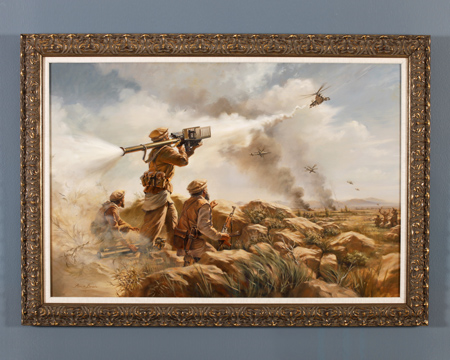
File:First Sting.jpg


Commons is a freely licensed media file repository. You can help.
Summary
| Author |
Stuart Brown |
| Object type | painting |
| Description |
English: First Sting, Oil on Canvas.
In 1979, the Soviets invaded Afghanistan to protect its new socialist puppet government. The US along with the vast majority of nations condemned this Soviet attempt to extend its colonial domination. The Mujahedin, Afghan rebels fighting Soviet occupation, were ill-equipped to defeat the far superior Soviet forces. Initially hoping to tie Moscow down in a prolonged war of attrition, the US provided the Mujahedin with only limited support. President Reagan championed the idea that if the Mujahedin forces actually defeated the Soviets in Afghanistan, the broader impact would be to stem future global communist aggression. By 1985, America’s attrition strategy gave way to a more aggressive approach intended to inflict a humiliating defeat on the Soviet Union. The most audacious move was a 1986 decision to supply the Mujahedin with heat-seeking, shoulder-launched Stinger antiaircraft missiles. These missiles turned the tide of the war by giving Afghan guerrillas the capability to destroy their most dreaded enemy weapon in the rugged Afghan battlefield—the Soviet Mi-24D helicopter gunship. The first three Stingers fired took down three gunships. Rebel morale soared overnight. Devastating Soviet losses mounted. A Soviet retreat was within sight. In 1988, President Gorbachev announced his intention to withdraw Soviet forces from Afghanistan. The last Soviet soldier left in February 1989. Foreign Minister Shevardnadze later lamented, “The decision to leave Afghanistan was the first and most difficult step. Everything else flowed from that.” This view implied that the Soviet defeat in Afghanistan led to the eventual fall of the Berlin Wall and collapse of the Soviet Union. First Sting depicts the turning point in the Afghan war with the first of many shoot-downs of Soviet helicopter gunships by Mujahedin fighters armed with Stinger missiles. |
| Date | 2008 |
| Source/Photographer | Central Intelligence Agency Official Web-site, CIA Museum Art Collection |
Licensing

|
This image is a work of a Central Intelligence Agency employee, taken or made as part of that person's official duties. As a Work of the United States Government, this image or media is in the public domain in the United States.
|

|
File history
Click on a date/time to view the file as it appeared at that time.
| Date/Time | Thumbnail | Dimensions | User | Comment | |
|---|---|---|---|---|---|
| current | 16:10, 30 April 2018 | | 1,582 × 1,056 (377 KB) | ВоенТех | User created page with UploadWizard |
File usage
The following 2 pages use this file:
Global file usage
The following other wikis use this file:
- Usage on de.wikipedia.org
- Usage on fa.wikipedia.org
- Usage on ko.wikipedia.org
- Usage on pl.wikipedia.org
- Usage on ru.wikipedia.org
