Leeches are segmented parasitic or predatoryworms that comprise the subclassHirudinea within the phylumAnnelida. They are closely related to the oligochaetes, which include the earthworm, and like them have soft, muscular segmented bodies that can lengthen and contract. Both groups are hermaphrodites and have a clitellum, but leeches typically differ from the oligochaetes in having suckers at both ends and ring markings that do not correspond with their internal segmentation. The body is muscular and relatively solid; the coelom, the spacious body cavity found in other annelids, is reduced to small channels.
The majority of leeches live in freshwater habitats, while some species can be found in terrestrial or marine environments. The best-known species, such as the medicinal leech, Hirudo medicinalis, are hematophagous, attaching themselves to a host with a sucker and feeding on blood, having first secreted the peptide hirudin to prevent the blood from clotting. The jaws used to pierce the skin are replaced in other species by a proboscis which is pushed into the skin. A minority of leech species are predatory, mostly preying on small invertebrates. (Full article...)
Brittle stars, serpent stars, or ophiuroids (fromLatin ophiurus'brittle star'; fromAncient Greekὄφις (óphis)'serpent'andοὐρά (ourá)'tail'; referring to the serpent-like arms of the brittle star) are echinoderms in the class Ophiuroidea. They crawl across the sea floor using their flexible arms for locomotion. The ophiuroids generally have five long, slender, whip-like arms which may reach up to 60cm (24in) in length on the largest specimens. (Full article...)
Platyhelminthes (fromAncient Greekπλατύ (platy)'flat'andἕλμινς (helmins)'parasitic worm') is a phylum of relatively simple bilaterian, unsegmented, soft-bodied invertebrates commonly called flatworms or flat worms. Being acoelomates (having no body cavity), and having no specialised circulatory and respiratoryorgans, they are restricted to having flattened shapes that allow oxygen and nutrients to pass through their bodies by diffusion. The digestive cavity has only one opening for both ingestion (intake of nutrients) and egestion (removal of undigested wastes); as a result, the food can not be processed continuously. (Full article...)
The Bryozoa (also known as the Polyzoa, Ectoprocta or commonly as moss animals) are a phylum of simple, aquaticinvertebrate animals, nearly all living in sedentary colonies. Typically about 0.5 millimetres (1⁄64in) long, they have a special feeding structure called a lophophore, a "crown" of tentacles used for filter feeding. The bryozoa are classified as the marine bryozoa (Stenolaemata), freshwater bryozoa (Phylactolaemata), and mostly-marine bryozoa (Gymnolaemata), a few members of which prefer brackish water. Most marine bryozoans live in tropical waters, but a few are found in oceanic trenches and polar waters. 5,869living species of bryozoa are known. Originally all of the crown group Bryozoa were colonial, but as an adaptation to a mesopsammal (interstitial spaces in marine sand) life or to deep-sea habitats, secondarily solitary forms have since evolved. Five genera are solitary: Aethozooides, Aethozoon, Franzenella, Solella, which together make up the family Aethozoidae, and Monobryozoon, which has a statocyst-like organ with a supposed excretory function. (Full article...)
The coconut octopus (Amphioctopus marginatus) is a medium-sized cephalopod found in tropical waters of the western Pacific Ocean. It commonly preys upon shrimp, crabs, and clams, and displays unusual behaviour, including bipedal walking and gathering and using coconut shells and seashells for shelter.
Thysanozoon nigropapillosum, the yellow-spotted flatworm, is a species of marine flatworm in the family Pseudocerotidae. The species is native to the tropical Indo-Pacific region, where it lives in shallow reef habitats. Flatworms are hermaphrodites, each being able to act as either male or female. As a donor of sperm, it can grip the margin of the recipient's body, using its two penises in a chopstick-like manner, and deposit sperm on the surface of the skin of the recipient, even while it is actively swimming.
This picture shows a yellow-spotted flatworm photographed in Manta Ray Bay, on the island of Yap in the Federated States of Micronesia. The flatworm is seen swimming to the right at a depth of 12 metres (40ft) by undulating the margins of its body. The pseudotentacles at the front have simple eyes and sensory receptors to enable the flatworm to find tunicates on which it feeds.
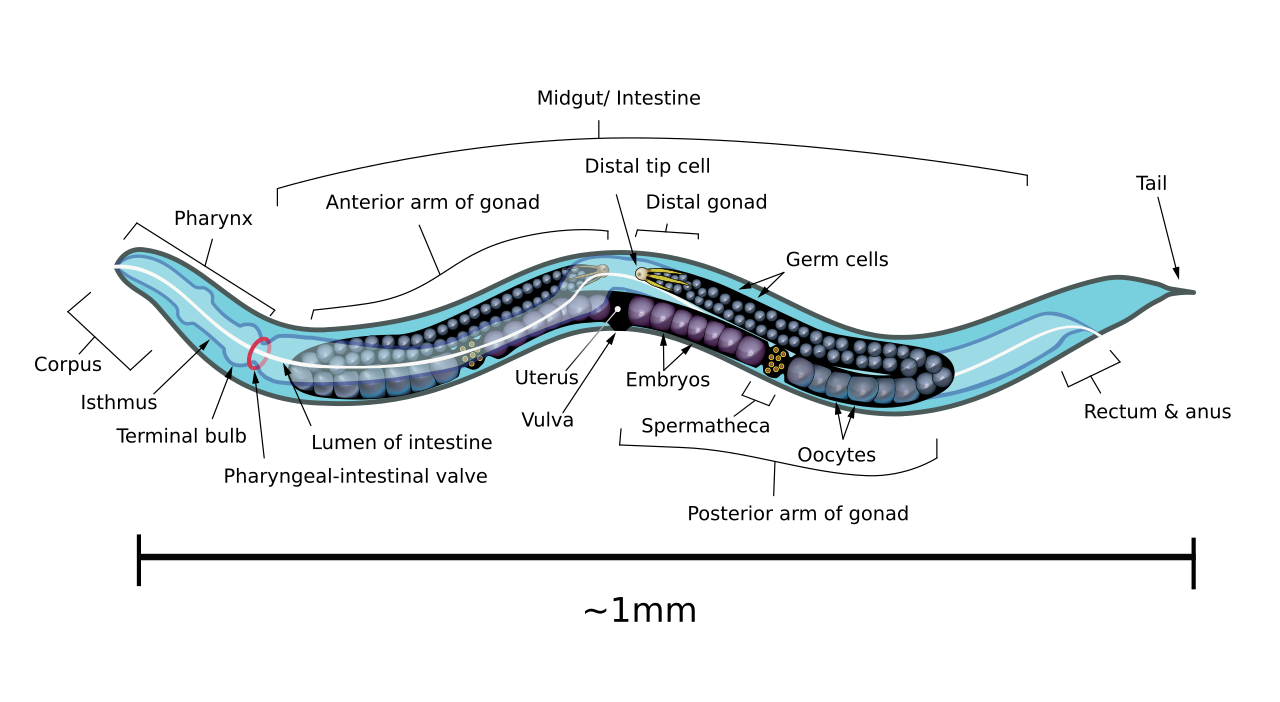
A lateral (left side) anatomical diagram of an adult-stage nematode hermaphroditeCaenorhabditis elegans (full size) with emphasis on the digestive and reproductive systems. C. elegans is a free-living, transparent nematode (roundworm) which measures about 1 millimetre (0.039in) in length. The hermaphrodite form, as seen here, is the most common, although a male form is also found. When self-inseminated, the species will lay about 300 eggs, but when the hermaphrodite is inseminated by a male, the number of progeny can exceed 1,000.
The Common Brushtail Possum (Trichosurus vulpecula) is the largest possum species and is perhaps the most widespread mammal in Australia. It grows to about 32–58cm (13–23in) in length, with an additional 24–40cm (9–16in) for its prehensile tail (seen here hanging below the branch). It is mainly a folivore, but has been known to eat small mammals such as rats. It is common in cities, having adapted well to human habitation.
Plate 5 from Ernst Haeckel's Kunstformen der Natur, showing a variety of calcareous sponges, a class of about 400 marine sponges that are found mostly in shallow tropical waters worldwide. Calcareous sponges vary from radially symmetrical vase-shaped body types to colonies made up of a meshwork of thin tubes, or irregular massive forms. The skeleton has either a mesh or honeycomb structure.
The Osprey (Pandion haliaetus) is a medium large raptor which is a specialist fish-eater with a worldwide distribution. It is often known by other colloquial names such as Fish Hawk, Sea Hawk or Fish Eagle.
The Osprey is particularly well adapted to its diet, with reversible outer toes, closable nostrils to keep out water during dives, and backwards facing scales on the talons which act as barbs to help catch fish.
Bolinus cornutus is a predatory species of sea snail, a marine gastropodmollusk in the familyMuricidae. This species is common along the west coast of Africa, where it prefers moderately shallow waters. The shell of the snail is distinctively large, spiny, and club-shaped, usually pale brown or tan in colour, with an elongated and straight siphonal canal.
Haliotis laevigata is a species of marine mollusc in the family Haliotidae, endemic to Tasmania and the southern and western coasts of Australia. This picture shows five views of a green H.laevigata shell, 7.5 centimetres (3.0in) in length. The holes in the shell, characteristic of abalones, are respiratory apertures for venting water from the gills and for releasing sperm and eggs into the water column.
Glaucus atlanticus is a species of small, blue sea slug. This pelagic aeolid nudibranch floats upside down, using the surface tension of the water to stay up, and is carried along by the winds and ocean currents. The blue side of their body faces upwards, blending in with the blue of the water, while the grey side faces downwards, blending in with the silvery surface of the sea. G.atlanticus feeds on other pelagic creatures, including the Portuguese man o' war.
Velodona togata is the only species in the octopus genus Velodona; the genus and species names come from the large membranes that connect its arms. It was first described by Carl Chun in his book Die Cephalopoden (from which this illustration is taken) in 1915. A second subspecies was described by Guy Coburn Robson in 1924.
The maxima clam (Tridacna maxima) is a species of bivalve found throughout the Indo-Pacific. It is found on the surface of reefs or sand, or partly embedded in coral (as with this specimen), in the oceans surrounding east Africa, India, China, Australia, Southeast Asia and the islands of the Pacific. This clam is much sought after in the aquarium trade, as its often striking coloration—the result of crystalline pigment—mimics that of the true giant clam.
The common clam worm (Alitta succinea) is a widely distributed species of marine polychaete worm. The photograph shows an epitoke specimen, the worm having turned into a form capable of reproduction. After releasing its sperm or eggs, the animal will die.
The sperm whale is the largest toothed animal on Earth. The species was hunted extensively by humans throughout history, until protected by a worldwide moratorium on whaling starting in 1985–86.
Entries here consist of Good and Featured articles, which meet a core set of high editorial standards.
Drawing of Apororhynchus hemignathi by Arthur Shipley in 1896. This is the original sketch of the first species in the genus Apororhynchus to be described.
Apororhynchus is a genus of small parasitic spiny-headed (or thorny-headed) worms. It is the only genus in the familyApororhynchidae, which is the only family in the orderApororhynchida. The body consists of a short, narrow trunk and a proboscis covered with hooks, which is used for feeding and attachment. The worms range from one to five millimeters long and around half a millimeter wide, with the females being significantly larger than the males. A lack of features commonly found in the phylum Acanthocephala (primarily musculature) suggests an evolutionary branching from the other three orders of class Archiacanthocephala; however no genetic analysis has been completed to determine the evolutionary relationship between species. The distinguishing features of this order among archiacanthocephalans are a highly enlarged proboscis which contain small hooks. The musculature around the proboscis (the proboscis receptacle and receptacle protrusor) is also structured differently in this order. This genus contains six species that are distributed globally, being collected sporadically in Hawaii, Europe, North America, South America, and Asia.
These worms exclusively parasitize birds by attaching themselves around the cloaca using their hook-covered proboscis. The bird hosts are of different orders, including owls, waders, and passerines. The life cycle of all Apororhynchus species remains unknown, but in common with other acanthocephalans, it likely involves a complex life cycle with at least two hosts. The intermediate hosts of Apororhynchus species have not been definitively identified, but it is believed to be an arthropod, such as an insect. Within this host, the larvae develop into an infectious stage called a cystacanth. When a vertebrate consumes the intermediate host, the cystacanths enter the vertebrate’s intestines where they mature into adult worms and reproduce sexually, and it becomes the definitive host. The resulting eggs are expelled and hatch into new larvae. Infestation by an Apororhynchus species may cause enteritis and anemia. (Full article...)
Image 4Idealised nephrozoan body plan. With an elongated body and a direction of movement the animal has head and tail ends. Sense organs and mouth form the basis of the head. Opposed circular and longitudinal muscles enable peristaltic motion. (from Animal)
Image 15The microscopic cave snail Zospeumtholussum, found at depths of 743 to 1,392m (2,438 to 4,567ft) in the Lukina Jama–Trojama cave system of Croatia, is completely blind with a translucent shell (from Fauna)
Image 16The blue whale is the largest animal that has ever lived; it can be up to 33.6 metres (110ft) long. (from Animal)
Image 25This frog changes its skin colour to control its temperature. (from Animal coloration)
Image 26A brilliantly-coloured oriental sweetlips fish (Plectorhinchus vittatus) waits while two boldly-patterned cleaner wrasse (Labroides dimidiatus) pick parasites from its skin. The spotted tail and fin pattern of the sweetlips signals sexual maturity; the behaviour and pattern of the cleaner fish signal their availability for cleaning service, rather than as prey. (from Animal coloration)
Image 29The red pigment in a flamingo's plumage comes from its diet of shrimps, which get it from microscopic algae. (from Animal coloration)
Image 30Butterfly wing at different magnifications reveals microstructured chitin acting as diffraction grating. (from Animal coloration)
Image 31A praying mantis in deimatic or threat pose displays conspicuous patches of colour to startle potential predators. This is not warning coloration as the insect is palatable. (from Animal coloration)
The following table lists estimated numbers of described extant species for the animal groups with the largest numbers of species,[1] along with their principal habitats (terrestrial, fresh water,[2] and marine),[3] and free-living or parasitic ways of life.[4] Species estimates shown here are based on numbers described scientifically; much larger estimates have been calculated based on various means of prediction, and these can vary wildly. For instance, around 25,000–27,000 species of nematodes have been described, while published estimates of the total number of nematode species include 10,000–20,000; 500,000; 10 million; and 100 million.[5] Using patterns within the taxonomic hierarchy, the total number of animal species—including those not yet described—was calculated to be about 7.77 million in 2011.[6][7][a]
↑The application of DNA barcoding to taxonomy further complicates this; a 2016 barcoding analysis estimated a total count of nearly 100,000 insect species for Canada alone, and extrapolated that the global insect fauna must be in excess of 10 million species, of which nearly 2 million are in a single fly family known as gall midges (Cecidomyiidae).[8]
↑Stork, Nigel E. (January 2018). "How Many Species of Insects and Other Terrestrial Arthropods Are There on Earth?". Annual Review of Entomology. 63 (1): 31–45. doi:10.1146/annurev-ento-020117-043348. PMID28938083. S2CID23755007. Stork notes that 1m insects have been named, making much larger predicted estimates.
1234Nicol, David (June 1969). "The Number of Living Species of Molluscs". Systematic Zoology. 18 (2): 251–254. doi:10.2307/2412618. JSTOR2412618.
↑Sluys, R. (1999). "Global diversity of land planarians (Platyhelminthes, Tricladida, Terricola): a new indicator-taxon in biodiversity and conservation studies". Biodiversity and Conservation. 8 (12): 1663–1681. doi:10.1023/A:1008994925673. S2CID38784755.




_(cropped).jpg)


_05.jpg)


.jpg)


.png)


.jpg)


_Naggar,_Himachal_Pradesh,_2013_(cropped).JPG)


.jpg)


.jpg)


 Commons
 Wikidata
 Wikiquote
 Wikisource
 Wikispecies
 Wikiversity
 Wiktionary