Showing posts with label Lou Marchetti. Show all posts

Sunday, August 9, 2026

Slice of P.I.: “A Key to the Morgue”

(Part of a series celebrating fictional private eyes.)


A Key to the Morgue, by Robert Martin (Ace, 1960).

This is the ninth of 13 novels Martin (1908-1976) produced starring Cleveland, Ohio, private investigator James “Jim” Tobias Bennett. The protagonist had initially been introduced as a law-school dropout in short stories for Dime Detective magazine in 1945; he made the big leap to book-length yarns six years later in Dark Dream. Unlike most fictional shamuses of his era, the black-haired, blue-eyed Bennett wasn’t a lone wolf, but instead a company man, heading the Cleveland branch of a New York-based national sleuthing agency. He also had a steady girlfriend, his long-legged secretary Sandy Hollis, whom he hopes to marry (though they never quite set a date to exchange vows).

A Key to the Morgue saw its original, hardcover publication in 1959 by Dodd, Mead. A reviewer for Goodreads sums up the plot this way:
Alvin Bayne is a man who started small in the produce business, but is now a rich man with contracts to supply major canning companies. Jim Bennett works for a private eye firm out of New York. Both men belong to a country club in Cleveland, or somewhere thereabouts.

When Alvin Bayne propositions Jim Bennett personally to gather evidence of his wife’s infidelity, Jim refuses on the grounds that it would violate his company’s policy. But then Alvin Bayne is so persistent and pathetic that Jim eventually agrees to meet up with him to discuss his situation, but of course when Jim arrives he finds Alvin Bayne lying with a bullet hole in his face, thus bringing all golfing activities to a grinding halt.

So Jim Bennett takes on the task of avenging his friend’s death, which straight away sees him dodging bullets and breaking detection protocol in the pursuit of suspects. The most likely suspects include Mrs. Bayne and her gangster lover John Damon, who have discovered through eavesdropping that Mr. Bayne is about to cut his cheating wife out of his will. But soon Jim Bennett is dealt a wild card in the form of Marsha King, the woman who Bennett learns was having an affair with Alvin Bayne while his wife was having an affair with John Damon. ... Marsha insists on accompanying Bennett on his mission to snap some pictures of John Damon and Mrs. Bayne in the act.

Add to all this the fact that Marsha King also has a romantic past with the criminal John Damon and you have a plot that would normally confuse the shit out of anyone, but Robert Martin makes it coherent by laying it out with trenchant style and the sure touch of a professional.
“This is by far the darkest, most violent of all the cases so far [in the series],” opined Gary Warren Niebuhr in Mystery*File. “Risking his license and his reputation, Jim rolls from one killing to the next trying to clear his friend’s name and eventually his own. Hard-boiled to the maximum, this cold and bleak tale is highly recommended.”

The paperback edition of A Key to the Morgue shown above features cover art by Lou Marchetti. Ace Books’ “Double Novel” packaging paired it with Odd Against Linda, by Steve Ward.

Thursday, February 29, 2024

Getting a Jump on Things


Happy Leap Day, gentle readers. This 1956 Ace Books cover of Leap in the Dark, by former actress and editor Rona Randall (aka Rona Shambrook), isn’t being highlighted today simply because of its title. It also hints at a project I have upcoming on this page, which will begin soon and likely run through most of March.

Meanwhile, a few words about the paperback novel at hand.

My Love-Haunted Heart, Sara Boyle’s terrific (but, sadly, no longer updated) blog about vintage Gothic romance novels, describes Leap in the Dark as “an interesting take on the mistaken identity plot twist.” She then synopsizes its plot thusly:
Jeanne Cleary is on her way to nursing college in London and on a whim hops off the train in a remote village in France. The station’s deserted so she follows a dusty path through the countryside leading her to the local chateau.

By a strange (very strange) coincidence, nurse-to-be Jeanne finds herself mistaken as an actual nurse (due to arrive that very day) who had recently been hired to look after the lady of the manor, Comtesse de Clementeaux.

Just as Jeanne decides to find a convenient time to break the news to her new found granny, another girl turns up—declaring herself to be Jeanne Cleary, the Comtesse’s granddaughter! The real Jeanne knows this new interloper is just a gold-digging impostor, but how can she reveal her true identity without breaking her own cover? So a sticky situation turns into a quagmire of confusion as our heroine battles to assert her rightful position within her newfound family and win the heart of the handsome Dr Paul Antoine.
The handsome painting that fronts Leap in the Dark was created by Italian-born artist Lou Marchetti (1920-1992), whose work has appeared on this page many times over the years. Boyle quips that “extra points [should be] given for this cover, as it’s refreshing to see a heroine dressed in something other than a floaty nightie.”

If you’re thinking this portends a similar demureness in the cover series I have planned for next month, fear not. There will be plenty of diaphanous attire and bared skin to admire. Stay tuned.

Monday, August 23, 2021

Another Look: “Georgia Hotel”

Warning: Artistic inspiration drawn from book titles may vary.


Left: Georgia Hotel, by “Scott Laurence,” aka Lily K. Scott and Laurence Kuntsler (Pyramid, 1952); cover painting by Rudolph Belarski. Right: Georgia Hotel, by “Scott Laurence” (Pyramid, 1957); illustration by Lou Marchetti.

Thursday, January 10, 2019

A Rich “Harvest” of Hammetts


It was 58 years ago today, on January 10, 1961, that author Dashiell Hammett passed away as a result of lung cancer at New York City’s Lenox Hill Hospital. To mark that sad occasion, CrimeReads has posted 20 different covers from Red Harvest—the first Continental Op novel, and “one of Hammett’s most political works”—which was originally released by Alfred A. Knopf on February 1, 1929.

Among the fronts on display are two of my favorites, a Spanish edition published in 1979 (shown above), and Permabooks’ 1958 version, featuring a cover illustration by Lou Marchetti (below). I also like (and even own a copy of) the 1961 Permabooks edition CrimeReads editors rank as No. 1, but I have to say, there are other Harry Bennett-painted paperbacks I prefer.


Perhaps only because it wanted to cap its selections at 20, CrimeReads neglected to feature two other versions of Red Harvest: Pan Books’ 1980 version (below, left), and a handsome 1989 paperback edition from Vintage/Black Lizard (below, right).


READ MORE:A Look at Hammett’s Red Harvest,” by William Lampkin (Yellow Perils).

Friday, December 21, 2018

Favorite Finds: “Faithful for Eight Hours”

Top vintage book fronts added to my collection in 2018.


Faithful for Eight Hours, by “Alfred Blake,” aka Laurence M. Janifer (Beacon, 1963). Cover art by Lou Marchetti.

Tuesday, April 10, 2018

Two-fer Tuesdays: Trip Traps

A twice-monthly pairing of book fronts that just seem to go together. Click on either of these images to open up an enlargement.


Journey Into Violence, by Harry Whittington (Pyramid, 1960), featuring a powerful cover illustration by Lou Marchetti; Journey Into Ecstacy, by Albert L. Quandt (Venus, 1951), with cover art by Howell Dodd (see Dodd’s original painting here).

Tuesday, November 15, 2016

Sights on the Sites

• A couple of years back, Killer Covers showcased a trio of paperback fronts emphasizing stairway dangers. More recently, Pulp International put together a much larger gallery with the same theme. From its choices, I’m particularly fond of E.T. French’s Never Smile at Children (1959), with cover art by Lou Marchetti.

• Speaking of Pulp International, dig this façade from Robert O. Saber’s Murder Honeymoon (1953), “a digest-style paperback from the Australian imprint Phantom Books.” The art,” we’re told, “originally fronted Saber’s 1952 Original Novels thriller City of Sin, … and was painted by the always amazing George Gross.”

• Boy, they sure don’t make magazine covers like this anymore.

Another fine specimen of that breed.

• I hadn’t previously noticed this novel-cover theme of women silhouetted in windows. But of course, now I’ll be watching for more examples every time I enter a bookshop.

Advice for do-it-yourself book-front designers.

• Ed McBain wrote so many novels, that assembling a complete collection of their fronts would be quite daunting. However, Bear Alley’s Steve Holland has made a running start at the task.

• And here’s something I wish was done more often: For the blog Criminal Intent, author Charles Finch interviews David Rotstein, the art director with Minotaur Books who created the jacket for Finch’s new Charles Lenox historical mystery, The Inheritance.

Friday, July 1, 2016

Friday Finds: “Some Like It Tough”

Another in our growing line of vintage book covers we love.


Some Like It Tough, by Jack Karney (Monarch, 1959).
Illustration by Lou Marchetti.

There’s no shortage of vintage juvenile-delinquent novels, but this cover of Some Like It Tough is among my favorites. You look at those two young dockside habitués, and you just know their future will bring a whirlwind of tangled bedsheets and proliferating troubles. The artwork was done by Lou Marchetti, about whom I’ve written before on this page. And the plot description on the back reads:
In the dark streets of New York’s Lower East Side hot-tempered Mike Kinder and voluptuous Susan Warren had been lovers from their early teens—until Mike’s father was beaten to death on the waterfront.

Setting out to avenge the killing, Mike met blonde, free-loving Lori Maston, daughter of a big-time labor leader.

Swiftly he was drawn into a personal war with union mobsters—and in passionate pursuit of both girls who used the wanton methods and morals of the waterfront to win his love and caresses.
See what I mean about dangers in the offing?

I can’t tell you much about author Karney, but a Facebook page called Vintage Paperback and Book Covers provides this information: “Jack Karney was an American writer who plumbed the depths of our favorite gutters and alleyways. The tough New York streets replete with tough broads, hard-boiled P.I.s, punch-drunk palookas, and cops who are ruled by bad decisions give his work that patina of grit we so love. It’s all buried beneath suitably rough covers.” Among the other novels credited to him are Tough Town (1952, aka The Ragged Edge); Cop (1952), which features alovely cover painted by Stanley Zuckerberg; Halo for a Heel (1952), which he published under the pseudonym “Mike Skelly); There Goes Shorty Higgins (1953); Knock ’Em Dead (1955); Work of Darkness (1955); Cry, Brother, Cry (1959); Cut Me In (1959); The Knave of Diamonds (1959); Layout for Murder (1960); and Yield to the Night (1960). A New Yorker by the name of David Balella, who for years wrote a blog called Knickerbocker Village, posted this video showcasing many of Karney’s book fronts.

Wednesday, July 22, 2015

More Marchetti Is Good Marchetti


Somebody’s Walking Over My Grave, by Robert Arthur (Ace, 1961), with cover artwork by Lou Marchetti.

As I have been known to do on occasion, today I went back to an earlier Killer Covers post and made some revisions (including adding several additional book fronts). The post in question comes from 2010 and looks at the paperback work of artist Lou Marchetti.

I think you’ll like the changes. Check them out here.

Monday, June 8, 2015

Most Wanton


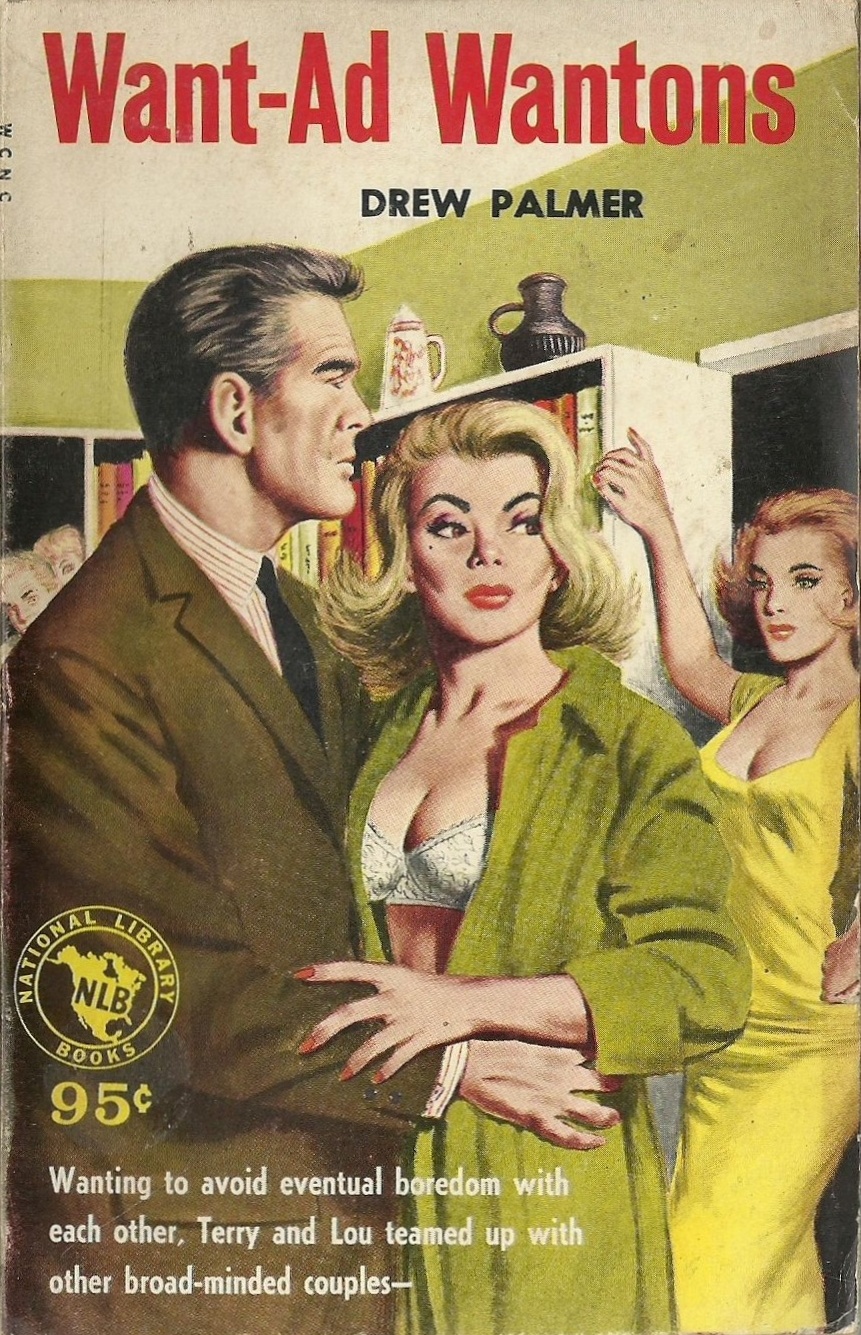
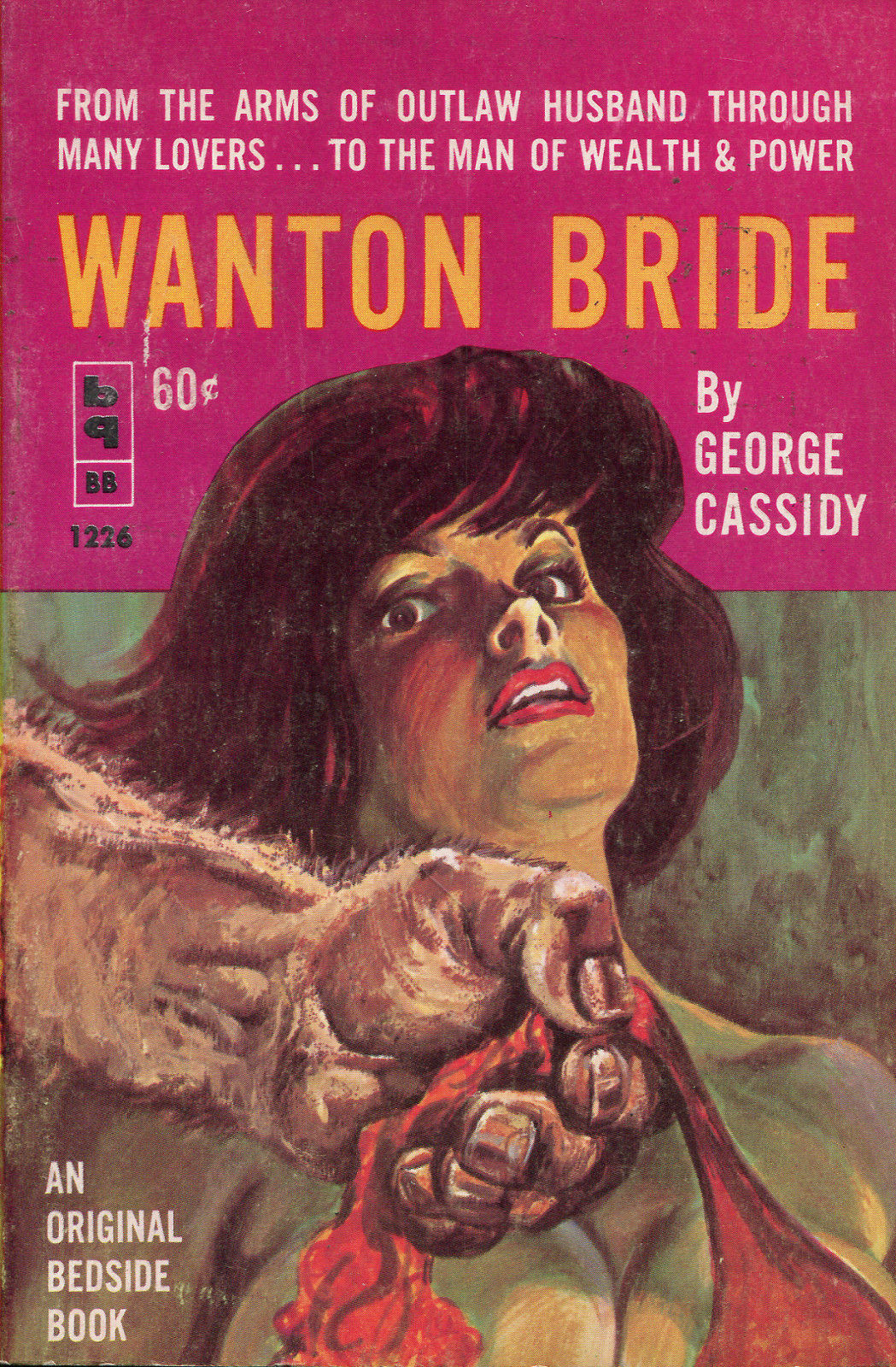
Being a longtime follower of crime fiction, I’m accustomed to the same words popping up frequently in book titles. How many times, for instance, have I seen dead, death, deadly, dying, murder, kill, killer, blood, darkness, and other such terms--all dog-whistle calls for genre fans like me--decorating covers in the Mystery & Thriller aisles of bookstores? But I wouldn’t have thought that wanton would receive anywhere near so much exposure. Pulling down my copy of The American Heritage Dictionary, I find the word has more than a few meanings, among them “immoral or chaste; lewd,” “gratuitously cruel; merciless,” “frolicsome; playful,” and “undisciplined, spoiled.” Perhaps because the term wanton covers such a wide range of behaviors, it has featured on many more books than I would have imagined before researching this subject.

I’m posting here a variety of covers employing wanton. The beautiful yellow one above is from 1955’s The Wanton Hour, by Lewis Clay. Sadly, I don’t find an artist’s name given on the back cover or anywhere online. (See “Update” at the bottom of this post.) Several of the novels below, though, carry art by prominent illustrators.

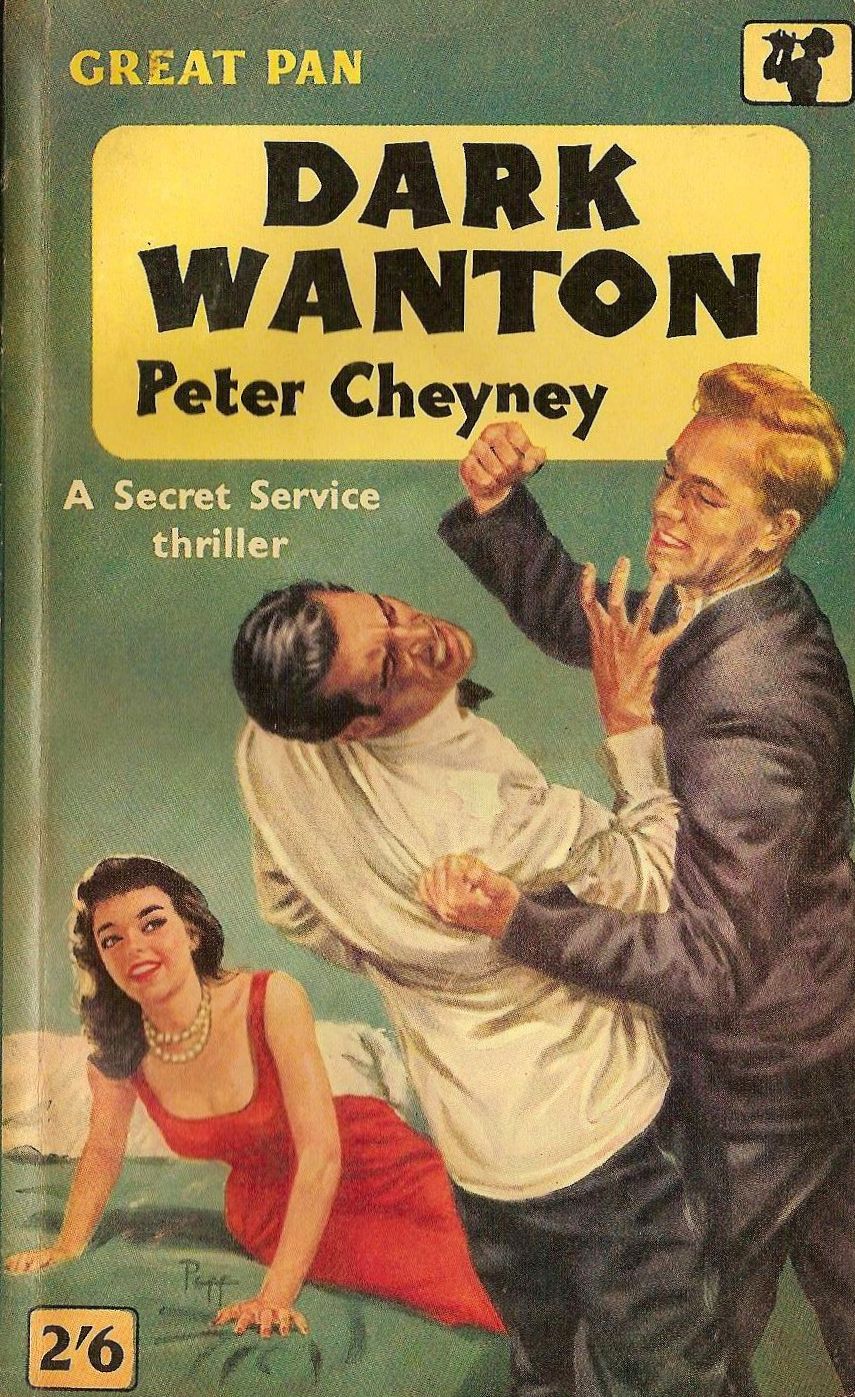
The two fronts from editions of Brett Halliday’s Murder and the Wanton Bride, for instance, were both executed by Robert McGinnis, as was the first of two covers shown here for Carter Brown’s The Wanton. (The façade of Richard S. Prather’s Way of a Wanton and the second Brown/The Wanton image are credited to Barye Phillips.) The first, green-backdropped, 1959 front of Peter Cheyney’s Dark Wanton below (the one with the young woman on a bed who, oddly, smiles while observing two men battle each other) was done by Sam “Peff” Peffer. Rudy Nappi created the cover of Weep for a Wanton, by Lawrence Treat. Harry Schaare executed the shadowy artwork for Michael Gillian’s Warrant for a Wanton. And Robert Bonfils is admirably represented by his work below on The Wanton One, by James Rubel, and Sweet, Young & Wanton, by Don Holliday.

Click on any of these images to open an enlargement.


Additionally, I came across a number of vintage paperback books--in the crime-fiction genre and others--that use wanton in their cover teaser lines. Roswell Keller illustrated the front shown here of Patrick Quentin’s Slay the Loose Ladies (originally titled A Puzzle for Wantons). Rudolph Belarski created the artwork fronting Never Walk Alone, by Rufus King. Bonfils was again the ribald genius behind the provocative façade of No Holds Barred. Maurice Thomas was responsible for the painting on the 1952 Signet edition shown here of Cleve F. Adams’ Sabotage. And Harry Schaare returned to give us the lovely artwork for Crime Cop, by Larry Holden.


Suggestions of more covers for this gallery, anyone?

UPDATE: At the time I assembled this collection of book fronts, I couldn’t figure out who’d painted the cover of the 1955 novel The Wanton Hour, by Lewis Clay. Only in late July 2015 did I stumble upon another, later paperback façade that seems to leave no doubt as to the answer. Check this out: The cover on the left comes from a 1958 edition of the novel The Mustard Seed, written by Vicki Baum, with an illustration by Lou Marchetti. (Click on the image for an enlargement.) Notice the passionate pair in the lower right-hand corner of that image. They look almost exactly like the two young lovers fronting The Wanton Hour. I can only conclude, therefore, that Marchetti was behind both illustrations. He must have created the painting for Clay’s novel first, then three years later employed the same embracing couple in his artwork for The Mustard Seed. Both works were published by Pyramid Books.